
PEI Wear Resistance Classes of Porcelain Stoneware: Guide for Commercial Project Outfitters
A mistake in choosing flooring for a commercial space can cost hundreds of thousands. If porcelain stoneware in a functioning mall or restaurant begins to wear out, crack, or lose color, the owner must halt business for repairs. To avoid this, architects and facility procurers rely on a strict international standard — the PEI wear resistance class.
Experts from the national B2B distributor Antey Group have prepared a detailed technical guide. We will break down how to properly read porcelain stoneware markings so that the flooring lasts for decades under extreme traffic conditions.
What is the PEI rating and why is it critical for business?
PEI (Porcelain Enamel Institute) — is an international rating for the abrasion resistance of glazed tiles. It is determined in laboratory conditions: an abrasive roller is applied to the tile surface, simulating the footsteps of people with sand and dirt on their soles. Depending on the number of revolutions at which visible damage appears, the material is assigned a class from I to V.
PEI Classification: Which porcelain stoneware can handle your traffic?
For commercial facilities, only classes starting from III are considered. Using lower classes is a direct violation of operational technology.
| PEI Class | Load Level | Application (Where to use) |
|---|---|---|
| PEI I - II | Minimal | Exclusively wall installation or bathrooms in private homes. Not suitable for commercial use. |
| PEI III | Medium | Small offices without street access, hotel rooms, boutiques with low traffic. |
| PEI IV | High | Restaurants, cafes, hotel lobbies, large office centers, medical facilities. |
| PEI V | Extreme | Malls, airports, train stations, supermarkets, entrance groups. Maximum protection. |
Selection Specifics for Different Commercial Types
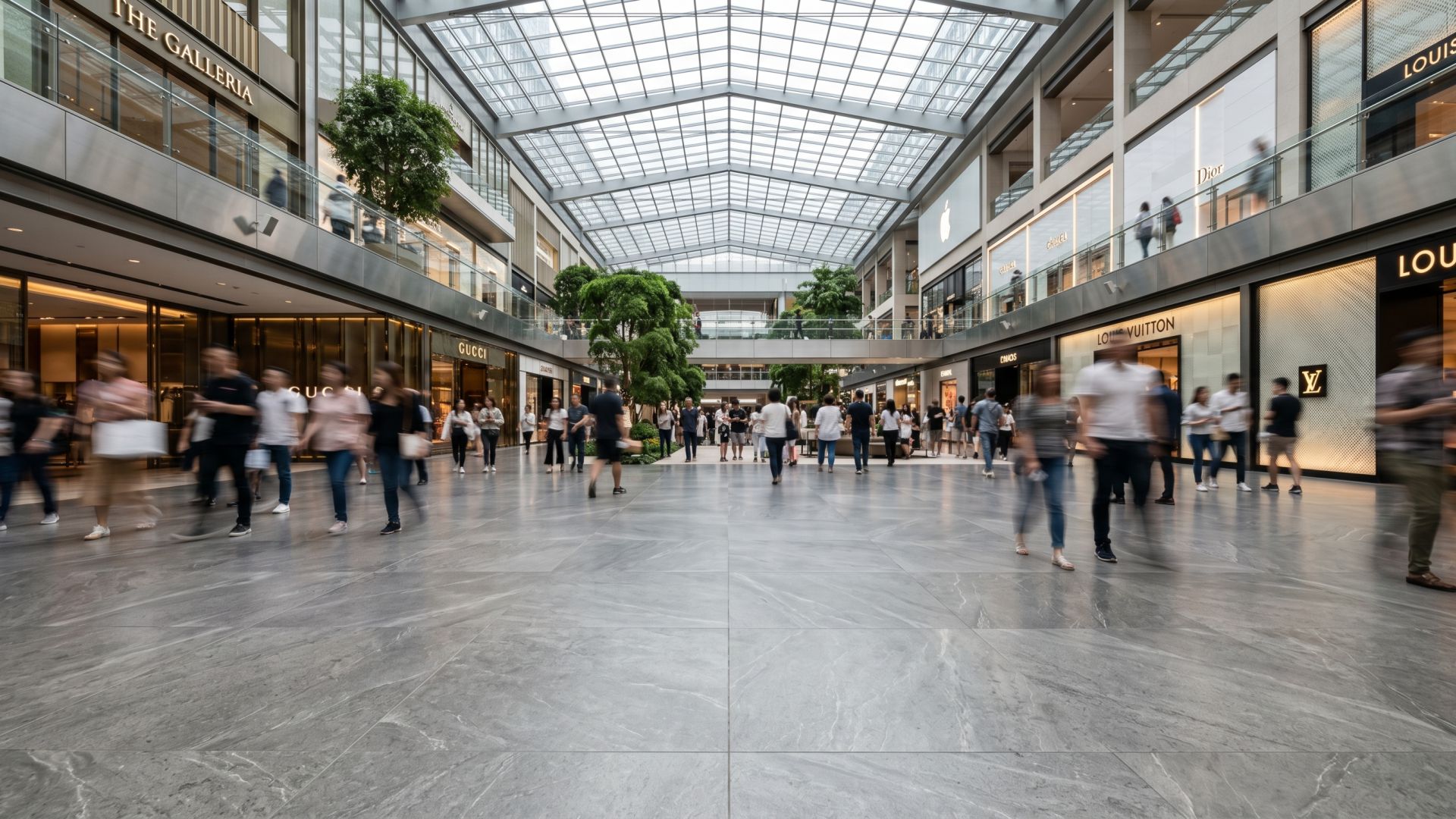
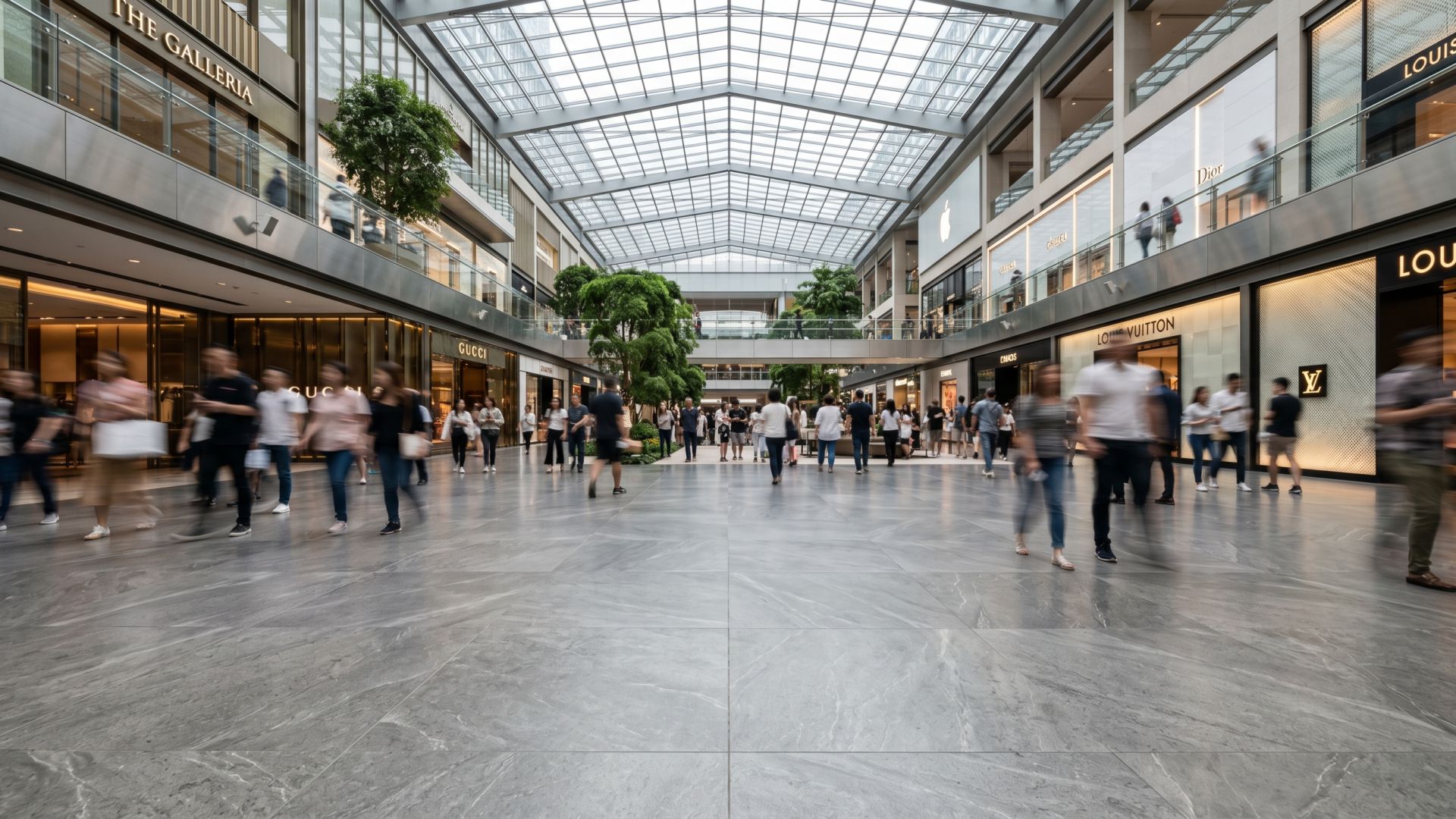
Malls and Supermarkets: Extreme Loads
For shopping centers where tens of thousands of people walk daily with abrasives (sand) on their shoes, and heavy cleaning equipment operates, glazed porcelain stoneware is often entirely unsuitable.
Expert Solution: Use homogeneous (unglazed) full-body porcelain stoneware. Even if the top layer wears down after 10 years, the color remains unchanged. Class — strictly PEI V. Reliable solutions are offered by Seramiksan, QUA Granite and Cerdisa.
Restaurants and HoReCa: Aesthetics plus Safety
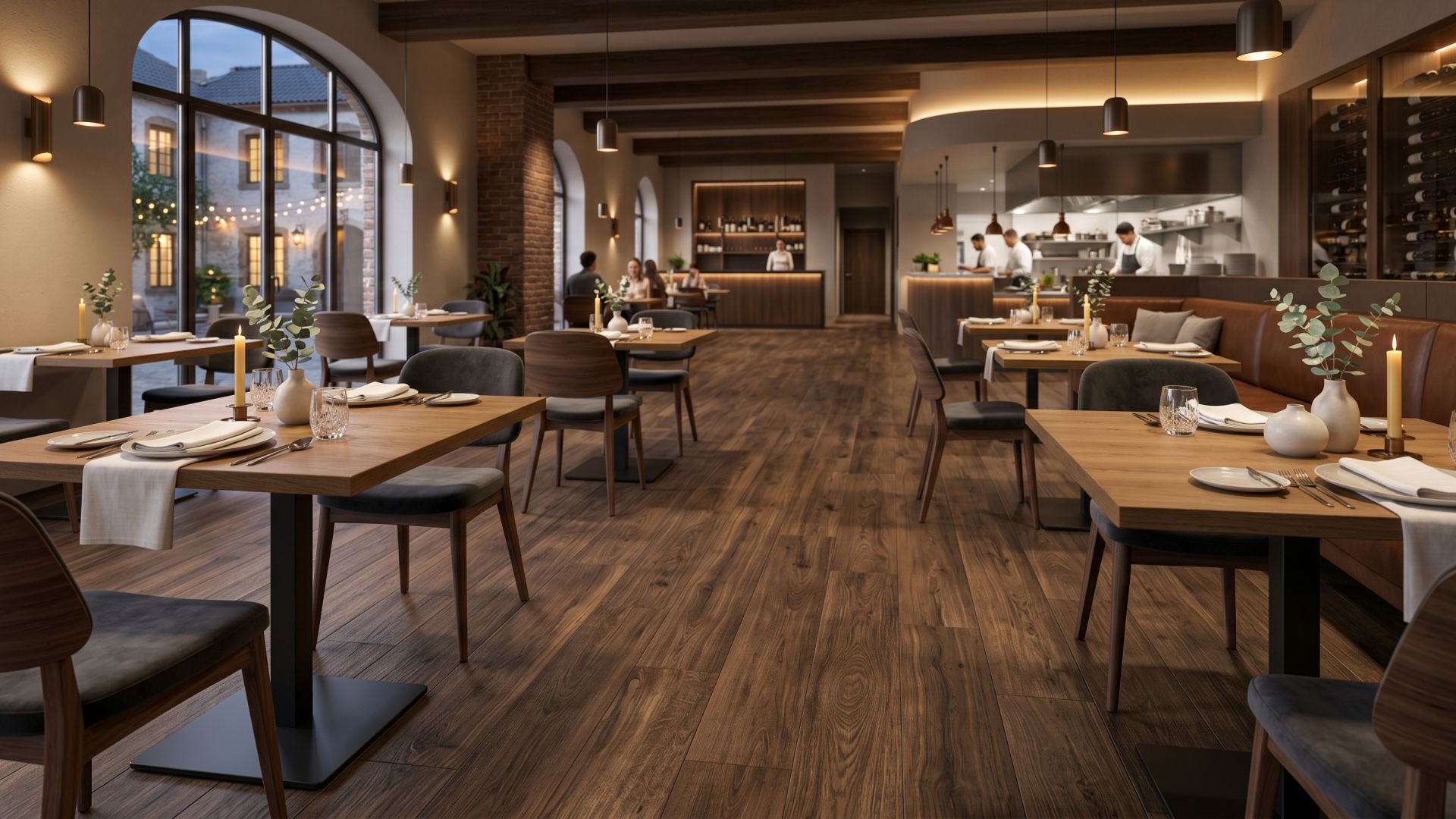
In dining establishments, the load is distributed unevenly. The main traffic is concentrated near the bar counter and at the restroom entrances.
Expert Solution: For halls, designer wood or stone-look porcelain stoneware (PEI IV) from Inspiro, Prissmacer or Peronda is suitable. For professional kitchens, the main criterion — is acid resistance and an anti-slip coefficient of at least R11-R12.
Office Centers: Localized Abrasion
The main enemy of an office floor is not dirt from the street, but the wheels of office chairs that rub the exact same spot for years.
Expert Solution: Porcelain stoneware PEI IV. Avoid perfectly glossy surfaces. Choose matte or lappato textures from the collections of Refin, Ragno and Pastorelli.
Beyond PEI: 3 Factors in Procurement
- Anti-slip (R-coefficient): For entrance groups, a rating from R10 to R13 (structured surface) is mandatory.
- Rectification: Choose exclusively rectified porcelain stoneware. It is laid with a minimal joint (1.5-2 mm), where dirt does not accumulate.
- Format: Large-format porcelain stoneware (60x120, 80x80) speeds up installation and makes the coating more monolithic.

Frequently Asked Questions about Porcelain Stoneware Wear Resistance
Can PEI 3 tiles be used for a restaurant?No, for restaurants and cafes with high traffic levels, it is necessary to use porcelain stoneware of a class no lower than PEI IV. Class PEI III will quickly lose its appearance under the constant impact of shoes and chairs.
Glazed porcelain stoneware has a pattern only on the thin top layer. Homogeneous (technical) full-body porcelain stoneware is colored throughout the entire thickness of the tile, so even with extreme abrasion in shopping centers (PEI V), it does not change color.
Facility Procurement with Antey Group
We select materials to fit your budget and provide logistics from our own warehouses. Learn more in our Comprehensive Supply Guide or view the conditions for wholesale purchase of porcelain stoneware.